On Marie Howe...
Poets' visions, writing while sad, living while dying, and what we're reading and watching now

It’s been a sad spring with real-life rites to mark, and so my creative life has taken a back seat. (It felt good to cold submit an old story to a dream journal today on a whim—that’s how trying these months have been.)
For too long I’ve had notes I took on a Jesuit Media Lab interview with Marie Howe (read about the Pulitzer Prize-winning poet and her latest collection here at JML) squirreled away in my cherished copy of her Magdalene: Poems. I have that collection to thank for helping me to understand I could weave my spiritual life and creative life together. (And, I mean, “Magdalene—The Seven Devils" Talk about brilliance (and so much relevance)!)
So, it was a dream to hear my favorite woman poet speak on growing up Catholic and writing and living her truths—with some inspiration. (She spoke of Mary, the mother of God and said “She’s a woman, first of all. I think of Mary as one of us, not one set apart.” And “I feel her company.”
Howe began this dream interview by reading her poem, “The Hymn,” which you can read here. It reminds her, she has said, that “one of the roles of the poet is vision.” The last line of the poem has stayed with me these four months, since I heard her read them (which tracks, since I sing a lot of hymns):
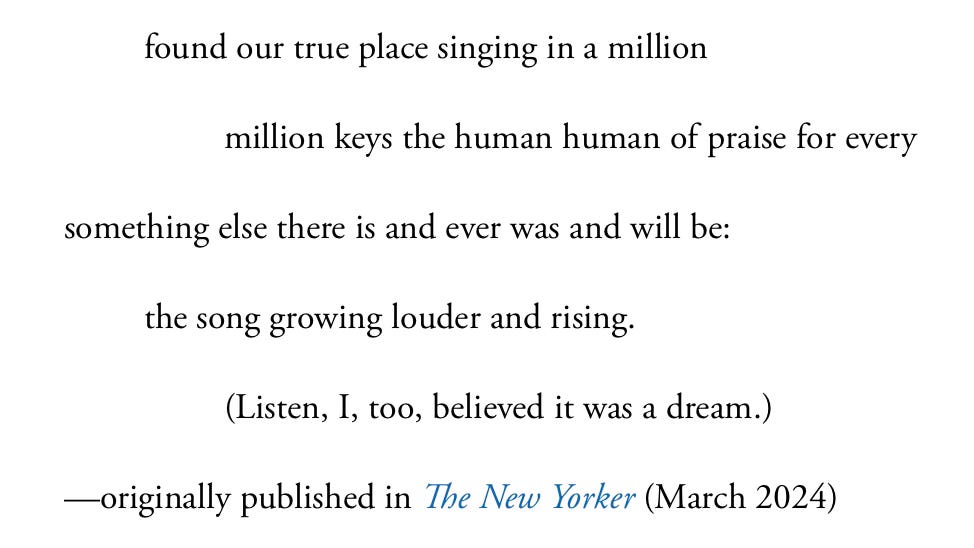
The idea of memento mori kept coming to me as I listened to Marie Howe speak. She said: “We are alive and we’re dying—that’s always been with me, but not in a haunted way.” She told the large Zoom audience about growing up and learning about the martyrs and saints and the sacred nature of life. She said, “Life is sacred. To be in relationship with life itself is a dream in and of itself.”
And that’s been really instructive for me, these months, as this past weekend we celebrated by late father-in-law’s life, while my extended family celebrated the life of a dear uncle back home in Ohio. So much to celebrate but also mourn. “Pain is inevitable. Suffering is a choice,” she said. “There’s pain in being alive.”
Howe was asked about what poetry means for her, does for her, and about her writing process. She spoke of poetry as witness and said the “stories coming out of [the immigration crackdown and protests in] Minnesota are poems.” She said “Poetry asks us to become more spacious.” And she said, “Truly I don’t write the poems. There’s something very spiritual about the act of having a poem come through.” Not to mean that it’s easy for her to write a poem, she said. “It takes me an enormous amount of time.”
I was heartened to know that the poet also struggles with distraction, “especially when there’s Instagram and elephants to look at” (and the Westminster Dog Show). Hear, hear, Marie Howe.
As a young person, she also struggled with a stutter—until she overcame it at age 30, an “act of God,” she called it. And she talked about reading poetry aloud, the way it’s supposed to be shared, about loving “the way in language each word is an event.” Remember the monotone way poets used to read their work, and then it was the NPR broadcaster whisper? On the matter, Howe said, “Just say the words.”
On who the poet reads: Jane Kenyon (and shouted out her The Boat of Quiet Hours: Poems), who was a close friend, and Mary Karr (and many others, I’m sure).
What I’m reading:
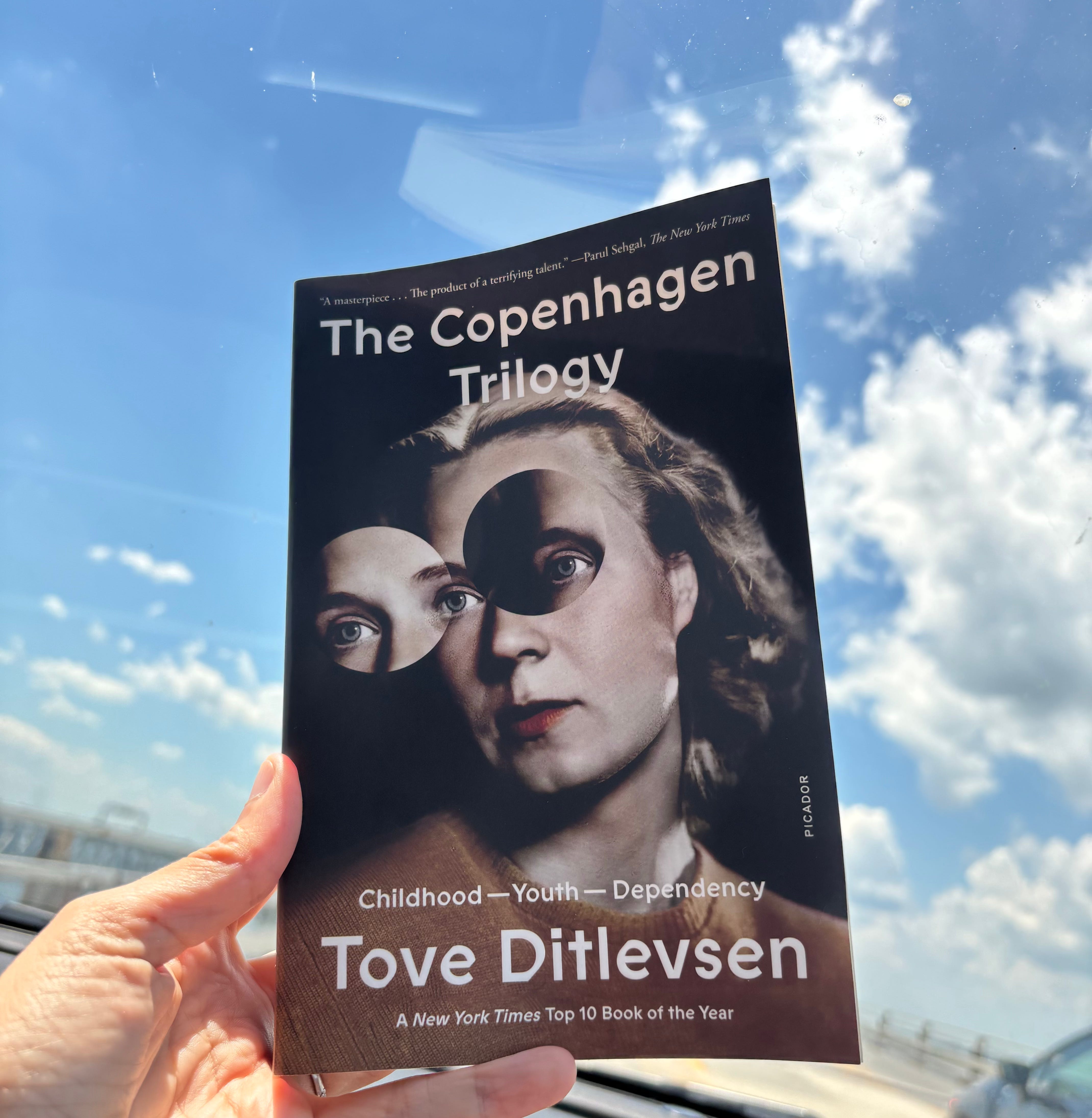
It started with a little Nordic Noir from Henning Mankell, spread to (Moomin creator) Tove Jansson’s writing for adults, and led to Dorthe Nors’ short stories and essays, which I followed to Tove Ditlevsen’s The Copenhagen Trilogy (all in translation, of course), the acclaimed Danish memoirs, which I’m now reading. So, it seems I have something for Nordic and Scandi writing—spare, sometimes-bleak, and generally spellbinding.
Over on FB, I talked about my latest antique store find (exciting—even though I’m not sure 2007 qualifies): a double-sided hardback issue of McSweeney’s Quarterly Concern 24, journal issue on one side and a “symposium” of writing dedicated to Donald Barthelme on the other.
Remarkably Bright Creatures by Shelby Van Pelt, which needs no introduction, and which also might make me stop eating octopus at Greek restaurants. Alas. Listening to the audiobook, actually. (Let me know what I should listen to on my long drive to Ohio this summer!)
Wellness by Nathan Hill, whose debut novel, The Nix, I adored! So far, I’m not liking this one as well, maybe because I liked the historical angle of the other. But I appreciate the Chicago setting and the round characters, so we’ll see.
What I’m watching:
I’ve been immersing myself in the choreography of Frederick Ashton (thanks, Marquee TV!), who was the founding choreographer of The Royal Ballet. The triple bill, Ashton Triple, is a good start. I knew I’d love “A Month in the Country,” starring my favorite dancer “Marianela Nuñez in a poignant portrayal of restrained passion, perfectly attuned to Chopin’s lyrical melodies.” (Oh, the beautiful costumes really add a lot! And the Chopin!) And I’m grateful that there are ballets with mature roles that perfectly capture Nuñez’s power and artistry as she dances through her 40s. What an interesting conceit—a ballet where a series of pas de deux moves the story forward.
“Rhapsody” (set to the music of Rach—swoon!) brings stellar dance duo Francesca Hayward and Marcelino Sambé together again. I loved them as lovers in The Royal Ballet’s adaptation of Like Water for Chocolate. But here they felt a little restrained (a little too English maybe)—the ballet is just not the perfect vehicle for such an artistic couple who can dance with such abandon. And Sambé’s footwork wasn’t as precise as it needed to be for this ballet’s signature style. I’ll give the third Ashton piece in the trifecta, “Scènes de Ballet,” which is set to Stravinsky, a try soon.
What I’m looking forward to:
Turning in to my press my anthology as it stands—that’s 18 articles, essays, and personal narratives (from 18 different writers) at the intersection of dance and health, along with three Q&As with health professionals with a focus on dance. Titled Body of Work, this collection (for the Connective Tissue series from West Virginia University Press) has been a joy to edit, but also a lot of work. The contributing writers make it all worthwhile. We’re looking at publication in early 2028, which feels like an eon from now. Wish me luck as I begin to draft the Afterword today!
My summer trip to Ohio, in August, will begin in Youngstown, where I’ll read with two other women writers (Becca J.R. Lachman, Renée Nicholson) for Lit Youngstown’s First Wednesday Reader Series. It’s held at Westside Bowl (yes, a bowling alley), making it all the more Youngstown-cool. If you’re in the area, come out and see us! After I get my fill of pickle and pierogi pizza, I’ll push west to visit my dad near Sandusky—where it’s all about lake life (and fried perch). Can you tell I’m hungry? We might get to Cleveland for the art museum and an orchestral concert one day, but other than that, it’s about Dad and my sister and catching up, lake- and poolside.
I love Marie Howe’s work and this is such a moving discussion of her work. And Rebecca, I’m THRILLED to be reading with you later this summer. YAY!
Ahh, can’t wait to hear more about this anthology!